Table of Contents
Entering the world of cryptocurrencies can feel exciting, but it can also be dangerous if you don’t know what you’re doing. A lot of people start investing in crypto because they hear others are making money fast, they see viral videos on social media, or they catch Bitcoin in the news. The problem is that if you jump in too quickly without understanding the basics, it’s very easy to make mistakes that cost you money and leave you thinking the entire market is just a casino.
In this article, we’ll go through the most common beginner mistakes in crypto and how to avoid them. Everything is explained in a simple, clear way so you can learn without getting overwhelmed.
This is educational content, not financial advice.
Entering crypto only because of FOMO and what other people say
One of the biggest common crypto mistakes is entering the market simply because everyone is talking about it. One day a friend tells you they made money on Bitcoin. The next day you see a video of someone showing huge profits. Then the news says crypto is pumping. In your head, a thought appears: “If everyone is in and I’m not, I’m the fool.” That’s FOMO: the fear of missing out.
When you invest because of FOMO, you’re not making a calm decision. You’re reacting to an emotion. And there’s a pattern you’ll notice if you pay attention: FOMO usually shows up after the price has already been rising for a while and the market feels “hot.” You enter late, you buy high, and when a correction hits, you panic, sell, and lock in a loss. After that, it’s easy to walk away saying “crypto is a scam,” when the real issue was the way you entered.
How to avoid this mistake is basically to do the opposite of what your body wants to do during euphoria. Instead of thinking “I have to buy right now,” pause and ask yourself what’s actually happening. Do you understand what this coin is? Why did it go up? How long has it been trending up? What could make it drop? If you can’t answer those questions, the smartest move is not to rush. The smartest move is to wait and learn before you press the buy button.
A useful mental trick for crypto investing for beginners is to treat hype like a warning sign, not a green light. When everyone is celebrating, risk is often rising, not falling.
Investing money you can’t afford to lose
Another brutal beginner mistake in crypto, and one of the most serious, is using money you need to live. Some people put their emergency fund into crypto. Others put rent money, money for bills, or even borrowed money into the market. This is a time bomb because crypto can be highly volatile: today it might be up 20%, and tomorrow it might be down 30% without any clear explanation in the headlines.
When the money you invest is money you need, every small dip becomes a crisis. You sleep badly, check your phone nonstop, get anxious, and eventually sell at the worst moment just to stop the pain. At that point you’re not investing, you’re gambling with your peace of mind. That’s why you hear the phrase “only invest what you can afford to lose” so often. It’s not a cliché. It’s the simplest reminder that crypto should never come before your rent, your food, or your basic stability.
A practical way to apply this is to think in percentages, not emotions. If you have savings, choose a small allocation, a percentage that would be annoying to lose but not life-changing. That might be 5%, 10%, or even less. Only you know the right number for your situation. The key is that if the position went to zero, you wouldn’t have to change your life because of it.
Buying crypto without understanding the project behind it
One of the most repeated beginner mistakes in crypto is buying something only because “I saw it on social media” or “people say it will multiply.” Many beginners don’t actually know what the token does. They don’t know if it’s used to pay fees, to secure a network, to govern a protocol, to play a game, or if it’s mostly driven by speculation. They only know it’s “going up.” The problem with that approach is that you have no foundation to hold through volatility when the price moves against you.
If you don’t understand a project, any rumor will shake you. You’ll hear someone sold, a negative headline appeared, another token is “better,” and you won’t be able to make a calm decision. The most likely outcome is that you buy impulsively and sell impulsively, with no plan and no clear criteria. That’s the perfect recipe for jumping from coin to coin, paying fees, losing time, and burning your patience.
Before buying any crypto, it’s worth spending even one afternoon learning what you’re buying. You don’t need to read a 50-page technical paper, but you should know the basics:
- What problem does the project claim to solve?
- Who built it and what is their track record?
- What real use does the token have?
- How does value flow through the system?
- What are the obvious risks?
Here’s a simple test: if you can’t explain out loud, in normal language, why you like a project, you probably aren’t ready to invest in it yet.
Learn the difference between a token and a project. A project can be useful while the token is overpriced. A token can pump even if the project is weak. Understanding that helps you avoid buying purely because a chart looks exciting.
Leaving all your crypto on an exchange as if it were a bank
Another classic beginner mistake in crypto is treating an exchange like a crypto bank. You buy coins, leave everything there, and forget about it. Sometimes nothing happens for a long time, but exchanges are private companies, not magic vaults. There have been cases of hacks, internal failures, and platforms that ran into liquidity problems and froze withdrawals.
When all your money is on an exchange, you’re trusting that company to always operate perfectly and never face problems. You’re not necessarily doing something “wrong,” but you are handing responsibility to a third party. That’s why you hear the phrase “not your keys, not your coins.” If the private keys aren’t yours, you don’t truly control the funds. The platform does.
The healthier long-term approach is to learn how to use your own wallet. It can feel intimidating at first because you go from “someone holds this for me” to “I am responsible for my keys,” but that’s an important step in crypto.
You can start small:
- Use a simple mobile wallet for a small amount
- Learn what the seed phrase is
- Practice sending a small test transaction
- Later, consider a hardware wallet for larger amounts
You don’t need to do everything on day one. But you also don’t want to stay forever in “exchange mode” with all your funds exposed to third-party risk.
Keeping no records of your crypto investments
When people start crypto investing for beginners, it’s common to do “test” transactions: buy a little of this, sell a bit of that, swap one coin for another. The problem appears months later when you no longer remember how much you deposited, what price you bought at, or which platforms you used. You only see one final number in your portfolio and have no idea if you’re doing well or not. It’s like driving with your eyes closed.
On top of that, in many countries you may need to report crypto transactions for tax purposes. If you keep no records, organizing everything later becomes chaos. You’ll be digging through exchange histories, wallet explorers, and old emails. And even then, you’ll forget details.
Keeping a basic record is not complicated. Open a simple document or spreadsheet and track the important information:
- date
- asset
- amount
- price (or total value)
- platform or wallet
- reason for the trade (optional, but very useful)
It doesn’t need to be perfect. It just needs to be understandable to you. Over time, you’ll be grateful you have a clear history to see your progress and avoid relying on memory or random screenshots.
Checking crypto prices every few minutes
You wake up and check the chart. You eat breakfast while checking the chart. You go to the bathroom with your phone in your hand. You go to bed and check again. This creates an emotional roller coaster that makes rational decisions almost impossible. One day you feel amazing because everything is green. The next day you feel crushed because a red candle appeared.
The problem isn’t only the time you waste. The bigger problem is the decisions that come from obsession. If you watch price every five minutes, every small move feels huge. A normal dip feels like the end of the world. A small pump feels like “now or never.” That leads you to buy at bad moments and sell out of fear, which is the opposite of what an investor should be doing.
To break this loop, you need conscious limits. If your plan is to hold crypto mid- to long-term, checking the chart twenty times a day doesn’t help. You can decide to check once per day, or even once per week, and spend the rest of your time learning, improving your strategy, and living your life.
The less you turn price into a source of anxiety, the easier it becomes to make rational decisions when it actually matters.
Blindly following influencers and internet “signals”
Crypto has an endless stream of content: YouTube channels, X accounts, Telegram groups, Discord servers, and all kinds of “signals.” It’s tempting to follow someone who looks confident and assume that if you copy them, you’ll get the same results. A major beginner mistake in crypto is forgetting that they don’t have your circumstances, your budget, or your goals. And many times, they have incentives you can’t see.
Some creators promote projects because they get paid. Others show only their winning trades and hide the losses. Some groups sell “private signals” and promise near-perfect accuracy. If you believe all of this without filters, you’ll probably buy assets you don’t understand and enter trades that don’t match your risk tolerance. When it goes wrong, nobody takes responsibility. You do.
A healthier way to use crypto content is to treat it as ideas, not orders. Listen, take notes, research independently, compare with other sources, and only then decide if it makes sense for you. If someone says something is “guaranteed” or “you can’t lose,” that should trigger instant distrust. In crypto, there are no guarantees, and anyone promising them is usually thinking more about their wallet than yours.
Extra value tip: ask one simple question about every recommendation: “How do they benefit if I buy?” If the answer is unclear, pause and investigate.
Neglecting basic crypto security
Many beginners treat security casually. They reuse the same password everywhere, stay logged in on a work computer, store their wallet seed phrase as a photo on their phone, or email it to themselves “so they won’t lose it.” While nothing happens, it feels fine. But the day someone gains access, the damage is often irreversible. In crypto, there is no “forgot password, send me a reset link.” If someone gets your keys, your funds can disappear.
Crypto combines technology and money. That means you should think like someone protecting a bank account, not like someone installing a game. Strong, unique passwords, two-factor authentication, and careful login habits are basics that make a huge difference.
The seed phrase is especially important. It is the master key to your wallet. If anyone has it, they can restore your wallet anywhere and drain it. That’s why the standard advice is to store it offline, written on paper (or a durable backup), in a safe physical location, far from photos, cloud storage, and email.
Taking security seriously isn’t paranoia. It’s common sense. Many losses don’t come from “elite hackers,” but from normal human mistakes: clicking a suspicious link, using a fake website that looks like an exchange, or sharing information because you trusted the wrong person.
Investing in crypto with no clear strategy
Some people spend months jumping in and out of the market without any plan. They buy a coin because it’s trending today, sell it tomorrow because something else looks better, then go back when they see it pumping again. Eventually they feel like crypto is pure chaos, but what was missing from the start was a strategy, even a simple one.
Having a strategy does not mean you must become an advanced technical analyst or stare at charts all day. It can be as simple as:
- investing a fixed amount every month into one or two assets you understand (a DCA strategy)
- holding positions for a minimum time regardless of short-term noise
- setting a maximum percentage for high-risk coins
- deciding in advance what “profit-taking” looks like
The point is to know why you’re doing what you’re doing, instead of letting emotions control your actions.
When you have a strategy, decisions feel clearer. Instead of asking “Should I buy? Should I sell? Is this the right time?” you ask one better question: “Does this fit my plan?” If it doesn’t, it’s probably impulse. If it does, you at least know you’re following a path you chose calmly.
That won’t guarantee results, but it will prevent a lot of avoidable mistakes.
Thinking you will get rich fast with crypto
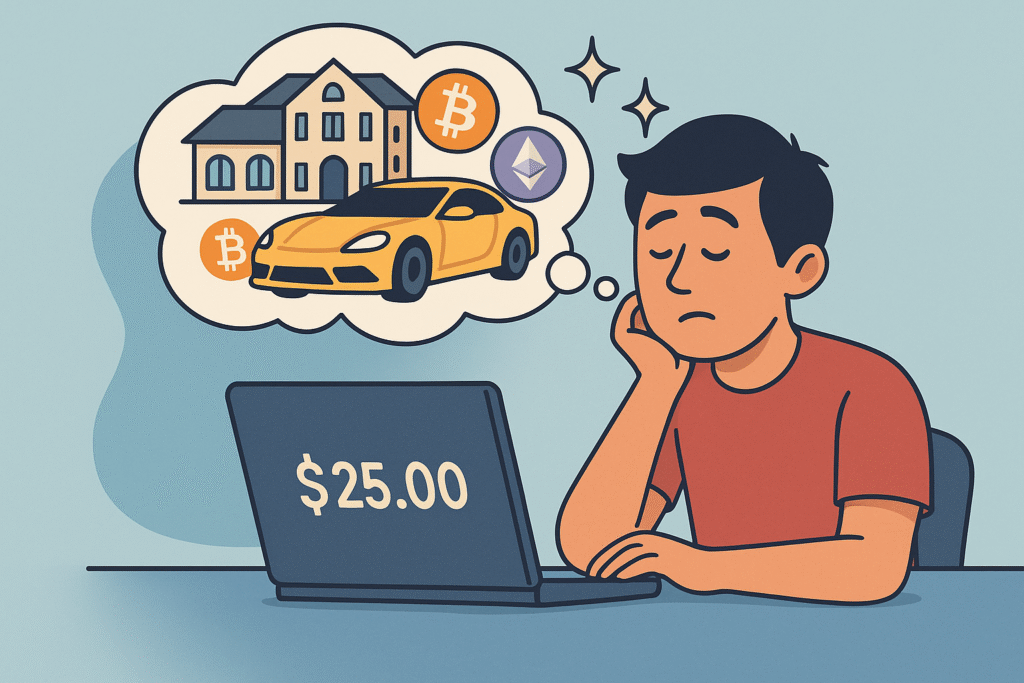
Stories about someone who bought a cheap coin and now lives in a mansion are emotionally powerful, but they almost never tell the full story: how long it really took, how many times it could have gone wrong, how much was luck, or how much money that person lost in other attempts before getting a win.
If you enter with a “get rich quick” mindset, you see everything through that lens. You hunt for the next 100x, you jump into projects only because they promise massive returns fast, and you get frustrated if nothing happens in a few weeks. That can push you into absurd risk, blind you to obvious red flags, and make you let other people make decisions for you. That’s exactly the mindset scammers exploit.
Changing this mentality is key for building a healthy relationship with crypto. Instead of thinking “I’m going to get rich,” a better approach is: “I’m going to learn how this works, and I’m going to protect my money while I learn.”
If you treat crypto as part of your financial education, not as a magic shortcut, your decisions will become much more grounded. Making money can be a result, but it should not be the easy promise you use to trick yourself at the start.
Conclusion: learn crypto mistakes before you pay for them
If you made it this far, you’ve already done something most people never do when they enter crypto: you stopped and reflected. Most people jump in because they feel rushed, because a friend is bragging about profits, or because a viral video promised fast money. You, on the other hand, are learning about beginner mistakes in crypto before making them, and that alone is a form of protection for your money and your mind.
The key point is this: cryptocurrencies are neither absolute salvation nor a financial demon. They are not an automatic ticket to freedom, and they are not a global scam designed to destroy you. They are a tool. A powerful tool, a new tool, and a volatile tool. It can help you if you learn to use it, and it can hurt you badly if you handle it blindly.
Just like you wouldn’t drive a race car without learning the basics first, it makes no sense to jump into the crypto market without a minimum learning phase.
All the mistakes we covered share one common root: a mix of ignorance and strong emotions. FOMO, greed, fear, pride, embarrassment about admitting “I don’t know.” When those emotions take control and you lack a solid foundation, the market becomes a distorted mirror of your impulses. Price goes up and you feel late. Price goes down and you feel like the world is ending.
The goal isn’t to become an emotionless robot. The goal is to stop making important decisions only because today you’re euphoric or today you’re scared.
The good news is that almost everything here can be improved with simple steps:
- read and learn before you buy
- invest an amount that won’t wreck your life if it goes wrong
- track what you do
- take security seriously
- accept that going slowly is not weakness, it’s an edge
In a market where everyone seems to be in a hurry, patience becomes a competitive advantage. While others jump from coin to coin chasing a quick hit, you can build knowledge that will benefit you for years, even if one day you decide crypto isn’t for you.
It’s also important to understand this: you don’t need to be right all the time to do this well. Nobody has a 100% win rate, no matter how confident they look online. The difference is how you respond when mistakes happen. You can use a mistake to punish yourself and quit, or you can treat it as tuition you paid for a valuable lesson. If each mistake teaches you something and helps you avoid repeating it, your learning curve becomes much faster than someone who only watches daily profit and loss.
At the core, crypto investing is less about predicting the future and more about understanding yourself: how much risk you can handle without losing your calm, what time horizon you truly have, what kind of projects fit you, and what triggers your emotions. The market will remain volatile with or without you. What you can change is your relationship with it.
Learn first, act second. That’s the simplest way for crypto to become an interesting part of your financial education instead of a chapter you regret a few years from now.
This content is not financial advice. It’s educational information designed to help you make more conscious decisions. Before investing in cryptocurrencies, always do your own research, compare sources, and if you think it’s necessary, speak with a professional who can assess your personal situation. Your money and your peace of mind are worth more than any short-term pump.
Quick beginner checklist
Before you buy any crypto:
- I understand what the project does in one sentence.
- I know the main risks and what could make it fail.
- I’m not buying because of FOMO.
- I’m investing only what I can afford to lose.
- I know where I will store it (wallet plan).
- I have 2FA enabled on the exchange.
- I will not store my seed phrase digitally.
- I have a basic plan: entry reason, time horizon, and exit rules.
- I will record the trade and keep tax-friendly notes.